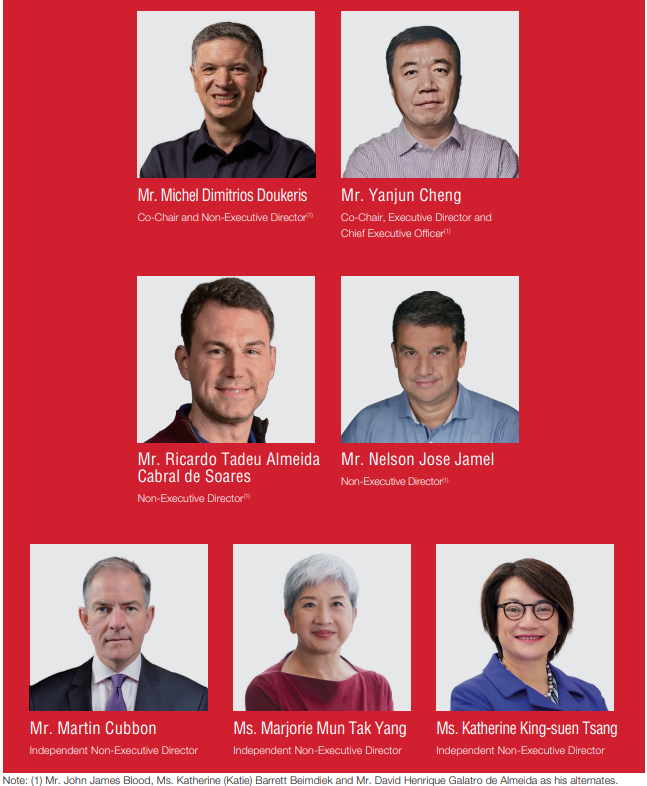
The Board, which is made up of a well-balanced combination of Executive and Non-Executive Directors, presently consists of seven members.
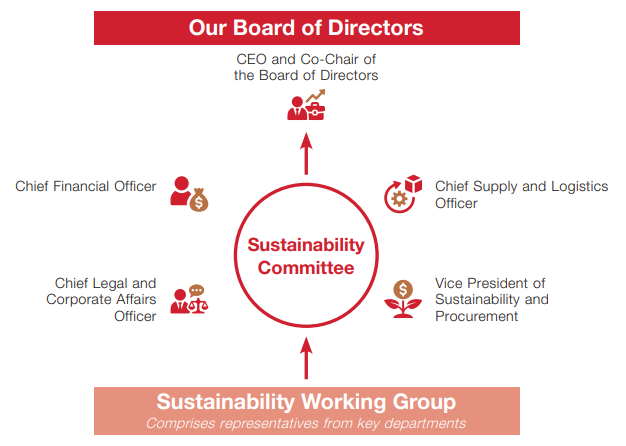


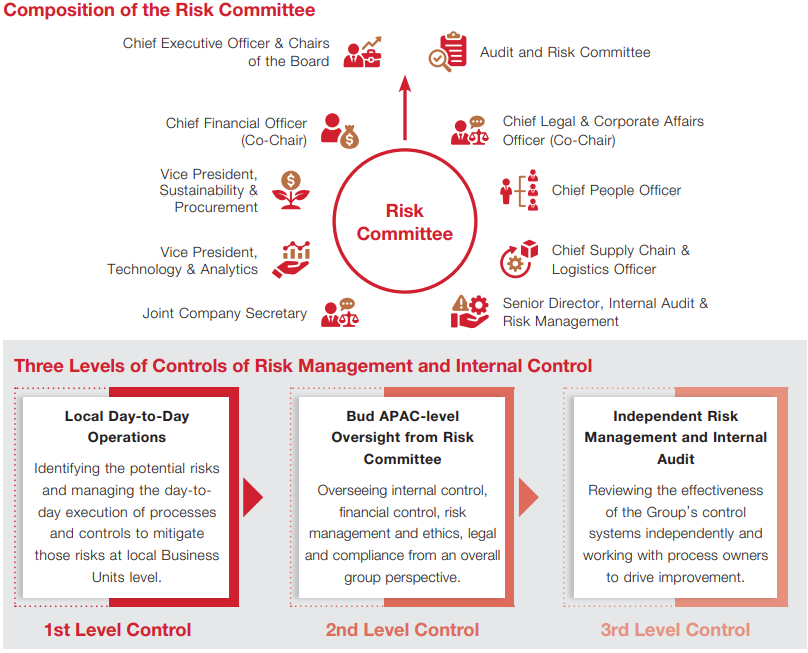
At the operational level, internal audit teams are tasked with conducting targeted audits of each business unit’s operations, guided by the findings of the annual Enterprise Risk Management (ERM) assessment. Additionally, we conducted an impartial evaluation of the efficacy of our risk management framework, incorporating a comprehensive benchmarking analysis against relevant industry peers.
Regarding our non-financial risk management, we engaged a third-party agency to verify our performance on carbon reduction, water usage, packaging management, and health and safety, and provide an independent assurance report on certain data points. Please refer to pages 60 to 62 of this Report for detailed information. Further information on our risk management and internal control systems is available on pages 54 to 61 of our Annual Report 2024.
Bud APAC strictly adheres to all applicable laws and regulations, diligently identifies and assesses risks associated with our operations, and employs appropriate technologies to implement monitoring measures, thereby minimizing compliance risks.
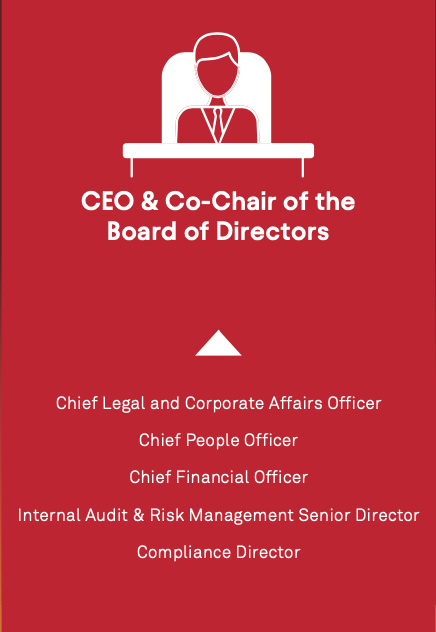
We have established an Ethics and Compliance Committee that is chaired by our CEO & Co-Chair of the Board and comprises of senior members of management. The Committee is responsible for overseeing the Company’s compliance with applicable laws and regulations to ensure that all business activities align with ethical and compliance standards.
To ensure our values are fully embedded, we regularly provide Code of Business Conduct trainings for employees and value chain partners, promoting the awareness regarding Bud APAC’s relevant policies and procedures. During the Reporting Period, the employee participation rate for the Code of Business Conduct training was 100%.
There were no material adverse judgments with respect to ethics and compliance matters (including corrupt practices) against the Group or our employees in 2024.


Stakeholder Engagement Approach
Bud APAC has various beer products, and our stakeholders have many different expectations. We are committed tostakeholder engagement — a process through which we aim to earn greater trust from stakeholders and cooperate withthem to achieve common goals.
To sustain our operations amidst an ever-changing competitive landscape, we aspire to anchor our decision-makingprocess on the adept identification of risks and opportunities, while accommodating the expectations of our stakeholders.
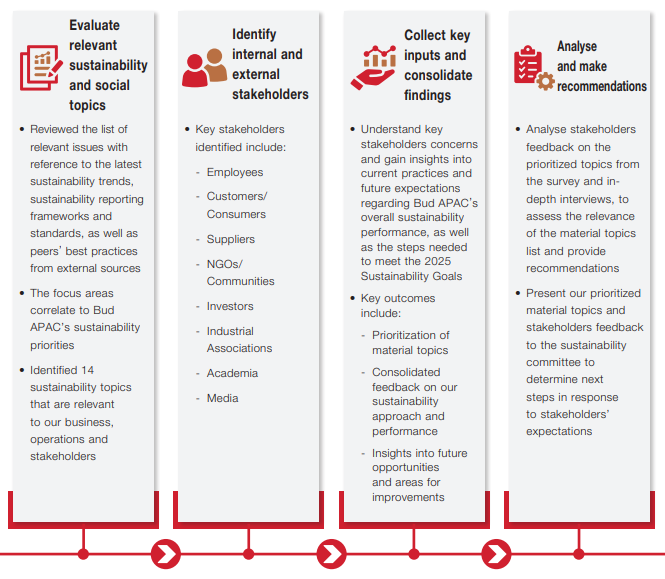
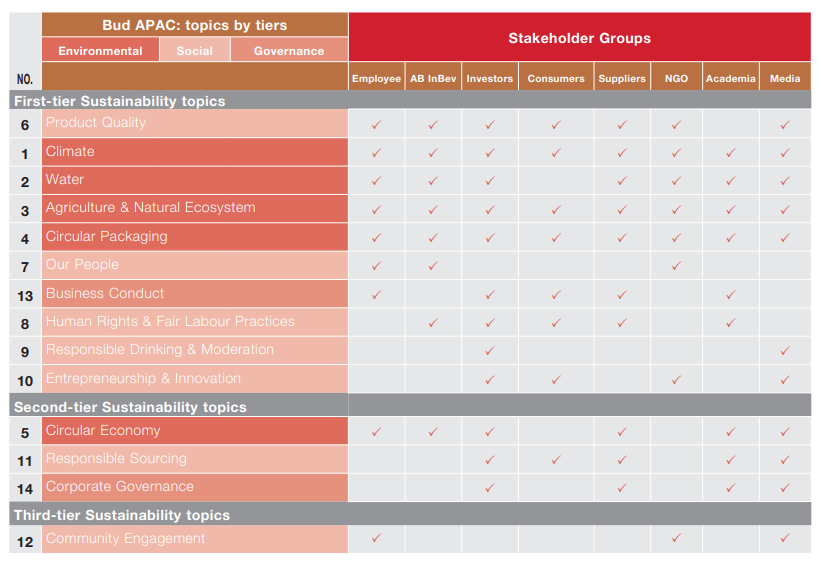
Consequently, we enlisted external consultants to undertake a comprehensive materiality assessment for Bud APAC.We conducted internal and external stakeholder surveys through questionnaires in 2024, as well as through a series ofin-depth interviews. We found that stakeholders have unique needs and expectations for Bud APAC.
Based on a comprehensive analysis of international sustainability reporting frameworks and industry-specific characteristics, we combined and optimised 14 material issues. Compared to the 23 issues identified last year, our analysis has becomemore precise and focused. This assessment enables us to clearly identify the issues that have significant impacts on BudAPAC and to prioritize our actions accordingly.
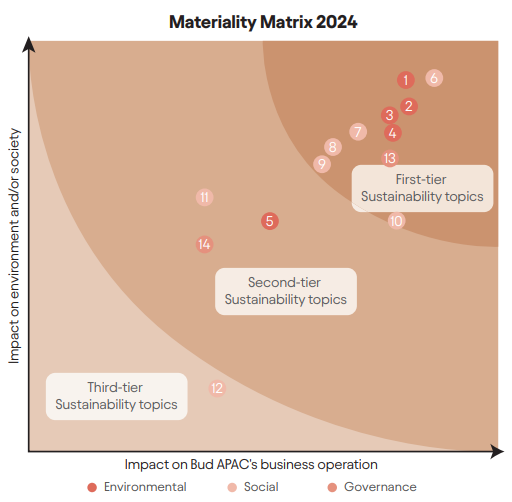
Topics with relatively lower priority tokeep in view and reassess.

Risks
Poor product control and food safety management may compromise product quality, leading to potential damage to brand reputation and loss of consumer trust. Stricter product regulations could result in legal disputes and challenges with market access.
Opportunities
We invest in technology research and development, optimising quality control process to monitor and refine product quality. This helps meet high consumer demand,foster brand loyalty and support market expansion.
Our Initiatives
• Implemented the Food Safety Policy to cultivate a robust food safety culture across operations.
• Established a food safety risk assessment methodology, which involves conducting process reviews, identifying hazards, assessing risks,implementing control measures, evaluating residual risks and updating food safety plans. This aim is to minimise food safety risks.
Risks
Climate-induced extremes such as floods and droughts may disrupt Bud APAC’s supply chain, increase business costs and potentially destabilise operations. High emissions may lead to regulatory scrutiny and damage our reputation.
Opportunities
Collaborating with value chain partners to advance the low-carbon transition via digital capacity-building and carbon footprint mapping reduces our overall greenhouse gas emissions. This proactive approach helps us gain a competitive edge in anticipation of future regulatory trends. Moreover, it can lead to long-term cost savings, especially in the face of potential high carbon tax trends.
Supporting local farmers in adopting sustainable farming practices improves the quality and reliability of agricultural resources. This reduces supply chain risks and costs, ensuring a stable supply of raw materials for us. Additionally, it can lead to long-term cost savings and improve our financial resilience.
Our Initiatives
• Our Scope 1 and 2 emissions have further decreased due to our continuous efforts in decarbonising. For detailed information about our initiatives and progress in this area, please refer to the “Climate Action – Our Initiatives” section on page33.
• Under our Supplier Strategic Alliance, we have implemented a plan to reduce Scope 3 emissions and are actively assisting suppliers in their transition to low-carbon practices, including initiating projects to replace natural gas with biomass fuel.• Supported one of our strategic suppliers in successfully achieving China’s first “carbon-neutral malt house”, in 2024, a result of our efforts in creating a closed-loop green production chain.
• Accelerated the adoption of RE100* initiative by deploying innovative sustainable technologies in breweries and further developing green logistics solutions, with 16 breweries in China that have already joined the RE100 initiative.

Risks
As the core ingredient of our production, water shortages may threaten our manufacturing and supply chain due to scarcity and pollution issues.
Water shortages can lead to increased costs associated with sourcing alternative water supplies or implementing water conservation measures.
Opportunities
By optimising water use through advanced technologies and collaborating with communities on water resource protection programmes, we could help minimise water risks, improve cost efficiency and promote sustainable development.
Regularly conducting comprehensive water withdrawal and risk assessments allows us to identify and address water-related risks in our operations and supply chain. This proactive approach helps us to avoid potential disruptions and costs associated with water shortages, ensuring stable production and supply.
Our Initiatives
• Conducted regular water supply risk assessments and water usage reviews across all facilities to minimise water risks
• Performed water management due diligence and promoted water reduction programmes among our suppliers, encouraging the reduction of water usage throughout the value chain.
• Partnered with local communities and increased investment in creating water recharge capacity in areas experiencing high-water stress.

Risks
Nature may disrupt supply chains and result in cost fluctuation.
Opportunities
We invest in sustainable agriculture practices, which help improve raw material quality and stabilise supply. We also participate in biodiversity conservation projects.
Our Initiatives
• Conducted comprehensive soil assessments to evaluate nature-related risks, gaining insights into impacts on and dependencies on natural resources.
• Avoided sourcing materials and operating in designated World Heritage Sites.
Risks
We may face higher taxes or penalties due to stricter packaging regulations. Additionally, our reputation may be affected by increasing consumer awareness of packaging and waste management issues.
Opportunities
We collaborate with our value chain partners to explore circular packaging solutions, including the use of returnable and recyclable materials.
Our Initiatives
• Assessed waste generation and landfill diversion to identify opportunities for waste reduction.
• Invested in circular packaging solutions and adopted green procurement practices to reduce waste, phaseout single-use items, and collaborate with suppliers.Disclosure Items: GRI 205; HKEX B4, B7
| Policy | Expectations |
| Code of Business Conduct | All employees are expected to uphold the highest standards of business ethics andintegrity, including protecting intellectual properties. |


|
Physical Security Protection
|
Committee Deliberation
|
|
The Data Centre is secured with restricted access, using man-trap doors, CCTV coverage and electronic card access systems, supported by a strict access authorisation process for security and prompt incident resolution.
|
The brewery’s Security and Safety Committee meets weekly to assess incidents, pinpoint essential operational and administrative requirements, uncover potential vulnerabilities, and devise risk mitigation approaches.
|
We conduct routine security activities, including quarterly phishing simulations to annual tabletop exercises and yearly cyber drills to enhance email security awareness, clarify roles during cyber incidents, and improve response processes, helping employees prepare to manage security threats.
Bud APAC requires all personnel to participate in annual information security training to stay updated on data security. Additionally, we provide customised security training sessions for specific teams and specialised training on data masking protocols for project managers and developers.
Bud APAC employs a comprehensive Third-Party Risk Management (TPRM) Lifecycle framework for APAC supply chain partners. This includes identifying and tiering third parties based on their access to our data or systems, followed by tailored risk assessments and corrective actions. Additionally, we conduct annual reviews and continuous monitoring of third-party tiers and cybersecurity risks, ensuring timely TPRM assessments and decisions on acceptance or rejection based on post-remediation risk levels.
In 2024, Bud APAC prioritized digital transformation across our operations, with a particular focus on enhancing internal systems for downstream retail and B2B teams.
| BrewDat System Optimisation | One Process Centre (OPC) | Bees Digital Sales Platform |
| Bud APAC leverages real-time data to optimise operational and sales approaches, guiding product placement and inventory adjustments to meet consumer demands. | Through the OPC, we streamlined our online procurement process, enhancing procurement transparency and operational efficiency with a unified approach to order placements and related workflows. | This tailored online system integrates order placement, inventory tracking and sales analytics, simplifying processes and strengthening the digital sales ecosystem for B2B and downstream retailers. |