Home SUSTAINABILITY Climate Action
Disclosure Items: GRI: 302, 305; HKEX: A1, A2, A4

Environmental Management

We have established comprehensive policies including our Environmental Policy, Packaging & Waste Policy, Water Policy and Climate Policy, each of which is regularly reviewed and updated. All policies are available on our website.


We have implemented the Operations Management Systems (OMS), Voyager Plant Optimisation (VPO) and Distribution Process Optimisation (DPO) across our APAC operations. The Environment pillar of VPO aligns our environmental management with Bud APAC’s environmental policy and strategy, as well as the ISO 14001 standards. All business units (BUs), suppliers, contractors and business partners working with Bud APAC must strictly adhere to these standards.


In 2023, Bud APAC had no major accidents or environmental violations related to air emissions, wastewater discharges, soil pollution, waste disposal, hazardous chemical substances, or other environment related areas. Last year, none of our operations in APAC were subject to any material environment-related fines or penalties.

Our Goals and Accomplishments

UN SDGs Our Goal KPI Measurements 2017 Baseline Progress in 2022 Progress in 2023 2025 Target


Goal 7: Affordable and Clean Energy


Goal 13:Climate Action


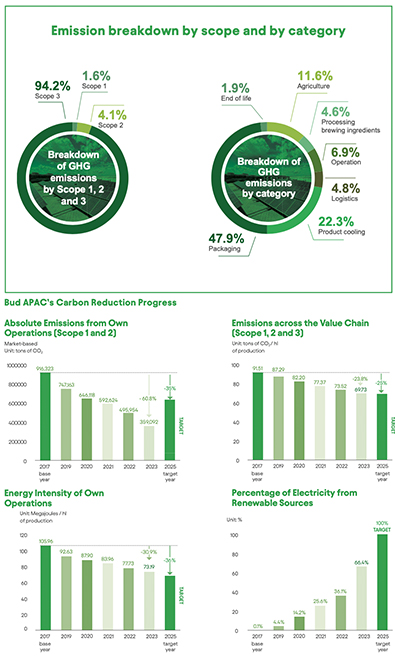
To increase purchased electricity from renewable sources % of purchased electricity from renewable sources 0.1% 36.1% 66.4% 100%
To reduce carbon emissions across our value chain % reduction of carbon emissions (tCO2e/hl) across our value chain (Scope 1, 2 and 3) 0% 19.7% 23.8% 25%
To reduce absolute carbon emissions within our operations % reduction of absolute carbon emissions (tCO2e) within our operation (Scope 1 and 2) 0% 45.9% 60.8% 35%
To reduce the energy intensity of our own operations % reduction of energy intensity (megajoules/ hectoliter) of production of our own operations 0% 26.6% 30.9% 36%

  • Our Approach

    Equipped with a comprehensive understanding of our GHG emissions throughout the value chain, we have developed a decarbonization plan that identifies key reduction opportunities, including:


    • Enhancing operational and energy efficiency at the brewery level through the adoption of advanced technologies to minimize GHG emissions;


    Incorporating low-carbon energy sources throughout our operations and value chain;


    • Encouraging energy-efficient and low-emission practices among our value chain partners, particularly strategic suppliers for packaging and raw materials, as well as logistic partners;


    • Supporting our suppliers to build their carbon baseline and decarbonization roadmap, we facilitated carbon footprint mapping for 40 suppliers and 90 sites.


    Promoting circularity initiatives to mitigate GHG emissions originating from packaging and waste;


    • Pioneering innovative cooling solutions as alternatives to conventional refrigerants;


    Exploring nature-based solutions to eliminate any remaining GHG emissions; and  Collaborating with industry stakeholders, policymakers, non-governmental organizations (NGOs), and other key actors to foster innovation and drive progress.

Our initiatives

Further Decarbonization

We implemented multiple initiatives to reduce carbon intensity across all our operations.


Scope 1 and Scope 2
Actions
Electricity from renewable sources

  • China
    • 10 breweries achieved RE100. 
    • 14 breweries in China have in place to implement solar panels, with totally 36 million kWh of electricity generated in 2023. 
    • Our Jinzhou brewery in China became the first in APAC to pilot Carbon Capture Utilization and Storage (CCUS) technology within the beer industry. By capturing carbon dioxide (CO2) generated during the fermentation process, we have been able to transfer CO2 surplus at a high (99.99%) purity level to facilitate natural energy resource recovery at a nearby partner site. 
  • India
    6 breweries in India have in place or are contracted to implement solar panels for the on-site generation of renewable electricity. The solar panels installed in breweries generated in total 13.09 million kWh of electricity in 2023. 
    Our Mysore brewery is using the heat generated from biomass-fueled boilers in the wort boiling, bottle washing and pasteurization and diverse renewable energy sources such as solar, wind and hydro to increase the renewable energy ratio to 92% in the brewery. 

  • South Korea
    • OBC has pioneered the installation of solar panels in the South Korean liquor industry, starting with their Gwangju brewery. Furthermore, solar panels will be installed at the Icheon and Cheongju breweries by 2024. Once all installations are completed, the combined solar panels at the three breweries will generate around 12 million kWh of renewable electricity per year. 
  • Vietnam
    The solar panels installed in the 2 breweries generated in total 1.2 million kWh of electricity in 2023. 
  • Our Vision and Ambition
    We have the ambition to reach net zero across our value chain by 2040, with an interim target of achieving 100% renewable electricity within operation and reducing GHG emission intensity by 25% across our value chain by 2025, aligned with our Science-Based Target. This ambition prioritizes the reduction of GHG emissions from our operations as well as across our value chain and allows us to prioritize climate-related risks and identify opportunities that are significant to us.

    Our Risks and Opportunities
    With increasing global temperatures and a rise in extreme weather events, climate change may have diverse impacts on our business, value chain, and communities. The natural environment, which plays a vital role in our operations, may be significantly affected particularly in terms of agricultural productivity and water availability. As water becomes scarcer in various regions, we may face risks in sourcing other critical natural ingredients.

    Our reliance on agricultural commodities such as barley, hops, rice, corn, wheat and various fruits makes us susceptible to weather fluctuations, droughts, and plant diseases.